Super Sleuth

Super Sleuth
Digging Up The Past One Relative At A Time

Sunday, April 3, 2016

ANCESTOR OF THE WEEK

Sebastiana Inserra-d'Angelo
1893-1994


Sebastiana Inserra was born in the small country town of Vizzini in Sicily, Italy on 4 December 1893.  She was the first child born to Carmelo Inserra and Domenica Maugeri.  As the first-born, her responsibility was to work in the family's salumeria, so she never attended any formal school.  Her younger brother and younger sister had the opportunity for schooling, but Sebastiana learned what she needed to by working daily in her family's store.  She became an expert in mathematical figures and could bargain with the best of them.  

In 1912, at the age of 19, she married Gaetano d'Angelo and nine months later gave birth to her first child, Giuseppa.  A second daughter was born in 1916, but unfortunately passed away a year later due to the Spanish Influenza.  

World War I changed the face of Italy, and when jobs and opportunities became scarce, Sebastiana, Gaetano, and Giuseppa set sail for America in 1920 entering Ellis Island on 9 February.  The little family moved into an apartment on Chrystie Street in Manhattan, New York.  Eventually, Sebastiana obtained a job in the garment district, Gaetano worked for a toy company, and Giuseppa went to school.

Sebastiana learned to navigate through the streets of Manhattan even though she never learned English.  She also developed many friendships through her job and through the neighborhood.  She had a reputation of being extremely kind and helpful.  She was also known for her amazing culinary skills and would often treat her family to homemade pizzas, pastas, and desserts.  A head for business, she and her husband purchased a small bungalow out on Staten Island to be used as a summer dwelling away from the hustle and bustle of the city.  Eventually, the house would be given to her granddaughter as a wedding present.

Sebastiana was widowed in 1959, but she kept living her life and enjoyed time spent with her daughter, grandchildren, and great-grandchildren.  In the early 1980's, Sebastiana began showing signs of dementia and, after some time, needed to reside in a nursing home.  Over the years, her memory disappeared completely and she was unable to recall her family members, until finally, she no longer made eye contact.  Her daughter visited her every day even though her own mother didn't acknowledge her.

In 1992, Sebastiana became a great-great-grandmother.  A photo of the five living generations was taken for posterity.  In 1994, Sebastiana reached a milestone of 100 birthdays!  She lived ten more months before she was called home.

I would like to think that the legacy my great-grandmother created will continue to shine on in future generations.  She was an amazing and accomplished woman and is missed greatly.

Saturday, April 2, 2016

ANCESTRAL SPARKS ARE FLYING!

Back in Genealogical Action!

I took a short blogging sabbatical due to work obligations, but continued to research whenever I had the chance.  Many exciting mysteries were brought to light recently.  I would like to share some with you:

1.  Helping a Friend with a Road Block:

A few years ago, I had the pleasure of meeting a lovely couple.  They were born in the same town my ancestors hailed from in Vizzini, Catania, Sicilia, Italia.  This couple has been a constant source of inspiration to me as I continue on my journey of digging up the past.  Yesterday, I went to visit them for a little while and brought my laptop.  My friend, Marianne, was asking me how I was able to find so much information so quickly.  My reply to her was, "I'll show you."  Within three hours, we traced her roots back five generations and found out that she and her husband are FIFTH COUSINS!  They share the same 4x-great-grandparents.  Needless to say, she was overwhelmed and very excited at the amount of names and dates that were presenting themselves.  Ancestry.com and FamilySearch.org continue to provide me with excellent resources that enable me to make someone who is having trouble searching on their own very happy!

Ancestry
FamilySearch

2.  "I Didn't Even Know Who My Great-Grandparents Were!":

Sometimes, when I hit my own brick walls and cannot go further back in my own direct ancestry, I branch off to search for some of my aunts and uncles through marriage.  I decided to call my aunt in Nevada and asked her if she would permit me to do a little research into her family tree.  I told her that all I was interested in were names and dates.  She gave me the information that she knew of, which only really went as far back as her grandparents.  After receiving her permission, I got to work.  Seven hours later, I traced her roots back to the year 1130 A.D.!  Her 23rd-great-grandfather, Bertoldus Hubere was hanging out in France just waiting to be discovered!  I did not get much sleep that night because I was so very excited, so I printed out all the information I had gathered, packed it, stamped it, and sent it off to Nevada.  She was so overjoyed!

3.  A Gift from the Heart:

My mother-in-law is continuing to have difficulty researching her branches.  I am trying to aid her in this quest, but her ancestors are elusive.  We decided to take a break in searching her ancestors.  After all, if an ancestor wants to be found, they'll present themselves in their own time, correct?  Anyway, she mentioned her disappointment in only having two or three photos of my father-in-law when he served in the U.S. Navy.  There were small pictures that needed a new life, so her wish being my command, I tried coming up with something just for her.  I purchased some military picture frames and came up with this (see below).  I made one in honor of my father and two in honor of my father-in-law.  I gave one to my mother-in-law on Valentine's Day.

**Note:  If you are looking for gifts and/or replicas that are military-based, the following website has some amazing items.  I purchased a frame from them to display my father's U.S. Army medals.  Check it out!  

Medals of America


4.  A Shoutout to a New Friend:

About a week ago, I reached out to a gentleman named, Thomas MacEntee.  He is the founder of GeneaBloggers.  I wanted to ask him a few questions about how to turn a passionate hobby into a part-time career.  He not only answered my email the next day, but sent me some wonderful and helpful resources.  He was kind enough to list my blog on the Geneabloggers.com site.  Look below for the GeneaBloggers Badge!  Thank you, Mr. MacEntee for your friendship!

Geneabloggers--Thomas MacEntee, Founder


Thank you for reading my blog.  I hope that you find it informative and enjoyable.  This truly is my passion.  Happy hunting!

Saturday, November 15, 2014

Sign on the Dotted Line

     The past two months have been dedicated to searching a little further into the family tree.  Brick walls have been my nemeses over and over again, and I'm trying not to become discouraged.  If genealogy was simple, everyone would be able to trace their roots back to Noah!

     A couple of years ago, when I was just starting out on my family search, I came upon several records in the town of Marcianise, Caserta, Italy that were signed by my 3x-Great-Grandfather, Giosue Armiero (1812-1888).  I am not exactly sure what his signature meant on each of the birth, marriage, and death records of the town, but I'm assuming that he may have been a worker in the town hall.  What I can determine by this gem of a find is that:  1)  My 3x-Great-Grandfather was literate; 2)  He had a prominent job; 3)  The way he writes his "A" is very similar to the way I do; and 4)  Giosue is the Italian form of the name, "Joshua".


     There are other bits of information that may prove to be very valuable in your search.  For example, please consider the following document:


     This is an "Atti di Matrimonio", a marriage record for my 2x-Great-Grandparents, Luigi Varrera and Rosolina Sorvillo.  They were married on 12 September 1877 in Orta di Atella, Caserta, Italy.  The information on this record is priceless to me and enabled me to go back one more generation.  Here is some of the information that I have found that may be useful in your own research:

1)  My 2x-Great-Grandfather, Luigi, was 30-years-old when he got married.
2)  Luigi's profession is listed as a "guardiano", which translates into "guardian".  Perhaps he was a watchman or a policeman.
3)  I know that Luigi's father, my 3x-Great-Grandfather, Domenico Varrera, was already deceased at the time of this marriage.  I know this because Domenico is listed as, "figlio di fu".  When you have the "figlio/figlia di "fu"", it means that the person is deceased.
4)  Luigi's mother, my 3x-Great-Grandmother, Massima Pezzella, was alive at the time of this marriage.
5)  This record also tells me that Luigi was born in and a resident of Orta di Atella.
6)  My 2x-Great-Grandmother, Rosolina, was 24-years-old at the time of this marriage.
7)  Rosolina's occupation is listed as a "contadina", which could mean farmer or countryman.
8)  Rosolina's father, my 3x-Great-Grandfather, Giuseppe Sorvillo, was deceased at the time of the marriage, but her mother, my 3x-Great-Grandmother, Speranza Pellino, was alive.

     This marriage document gave me some fantastic hints.  Plus, if I "think outside of the box", the fact that their ages were presented, gives me a ballpark figure of the possible years they were born.

     Thanks for reading!  Happy hunting!


Saturday, September 13, 2014

"When You Just Feel a Connection"

     Hunting down people in your family tree can be an exciting endeavor, but there are times when you fly head first into a brick wall and cannot move any further.  In these instances, I try to slow down and focus on the things that I have found so far.  I read and reread the information I have gathered in my binders.  Sometimes I find something that I haven't seen the first time I looked at it.  This happens a lot and you should never get discouraged when those brick walls appear.  You just need to take a little break in your research.

     I have discovered many people in my family tree.  Currently, on my Ancestry.com account, I have about 800 people now dangling from the tree.  The names fascinate me the most.  Going back to the 1500's and 1600's, the styles of names are so elegant.  I love finding similar names because it means that people were named after their ancestors.  In Italian culture, this is very common.  Usually, the first-born male child will be named after his paternal grandfather.  The first-born female child will be named after her paternal grandmother.  The second-born male child and female child will be named for their maternal grandfather and maternal grandmother respectively.  

Joseph's and Giuseppe's Throughout the Generations:

     The above paragraphs can be better explained through some visual aids.  There are / were many Joseph's (Giuseppe's) in my family tree.  I will begin with the most recent generation and work my way backwards:

My Brother:  Joseph Esposito was named for my father, not my paternal grandfather.  I believe that was a decision made by my parents.  Not one male child on my father's side of the family was named for their paternal grandfather...perhaps because we've become more Americanized over the past few decades.

My Father:  Joseph Esposito was the second male child born to my paternal grandparents, so my father was named after his maternal grandfather.

My Paternal Great-Grandfather:  Giuseppe Varrera was also the second male child born to my great-great-grandparents, so he was named after his maternal grandfather.

My Paternal 3x-Great-Grandfather:  Giuseppe Sorvillo is the last leaf I can find on this branch of the family tree.  I am certain I will be able to go back further over time, but the brick wall presented itself.

THE TIES THAT BIND:

     As you can see, generationally, we hold on to our ancestors in some manner, shape, or form.  Particularly interesting is when multiple generations are alive at the same time.  I am so excited when I see multiple generations present at family parties or at friends' gatherings.  I am usually the one taking the photograph.  Here are some examples of multi-generational families:


A Four-Generation Photo:  (2014)  
In this photograph, taken by yours-truly, we have from left to right, my first-cousin; her grandson, her son, and her mother (my aunt).  As soon as I realized everyone was present, I HAD to take this picture.


A Four-Generation Photo:  (circa 1955)
In this photograph, we have from left to right, my uncle, my grandmother, my great-grandmother, and my 2x-great-grandmother.


A FIVE-GENERATION PHOTO:  (1992)

This is truly the masterpiece of my collection!  In this photograph, taken by my father, we have from left to right, my grandmother, my great-grandmother, my mother, my sister, and my nephew.  I am so happy to have this memento.  My great-grandmother was one month shy of her 101st birthday when she passed away two years after this photograph was taken.

Sunday, September 7, 2014

"You Remind Me So Much of..."

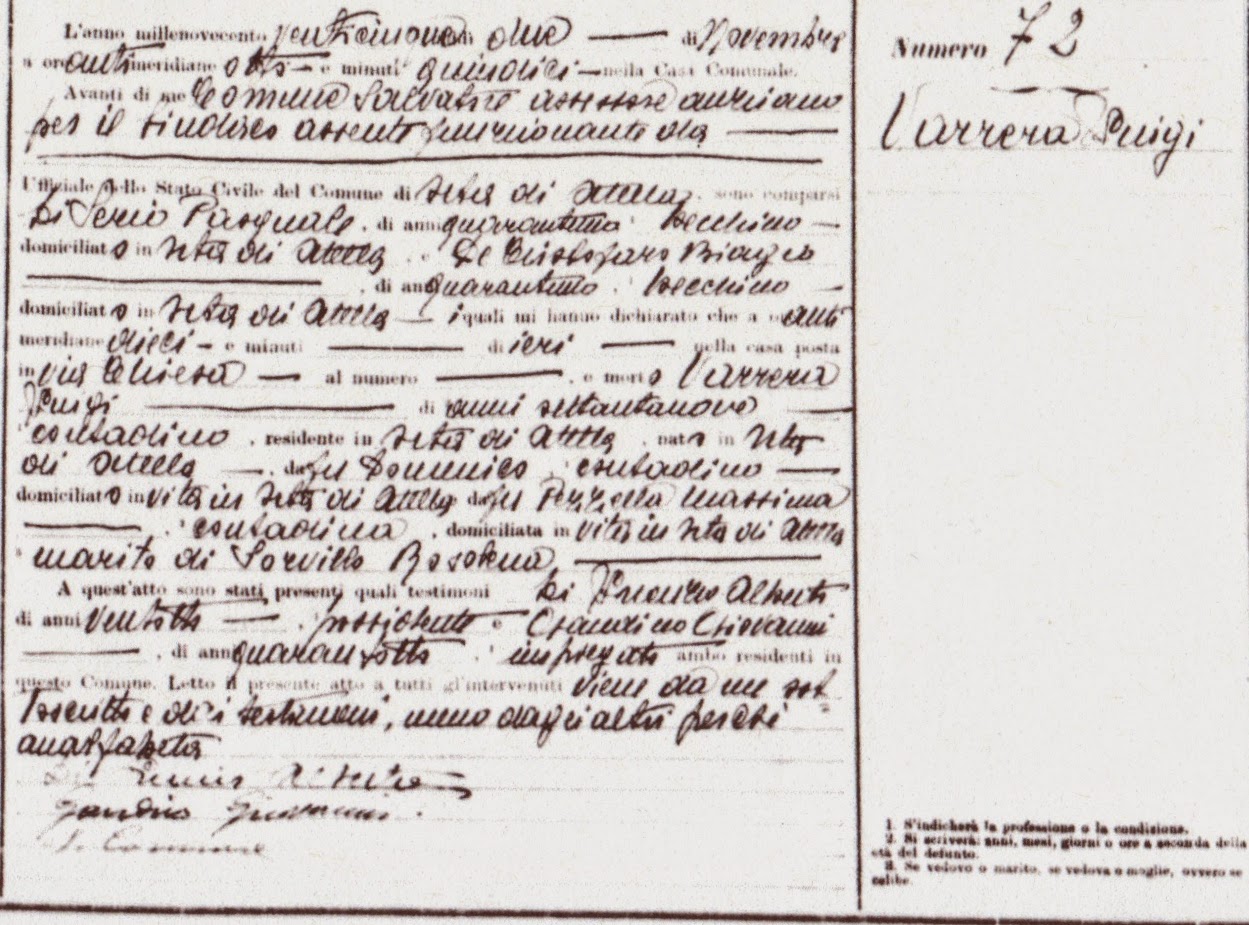
     One of the most interesting things I have discovered in my heritage hunting is that certain hobbies and interests that I have stemmed from ancestors of long ago.  Thanks to the "Atti di Morte" records on familysearch.org, I was able to know the professions of deceased ancestors, and quite surprised when I found out that some of the things I enjoy doing today was the livelihood of my ancestors.


     The above picture is a scan of the death record of my 2x-great-grandfather.  You can find a plethora of information on this type of document.  A working knowledge of Italian is not necessary, because there are many programs on the Internet that can help you translate any language into the language you are most comfortable with.  

     The information that I found out through this type of document is as follows:
1.  My 2x-great-grandfather's name was Luigi Varrera.
2.  He passed away on 2 November 1925 in Orta di Atella, Caserta, Italia.
3.  He was 79-years-old when he passed.
4.  His wife, Rosolina Sorvillo, my 2x-great-grandmother, was still alive at the time of his passing.
5.  His father's name was Domenico Varrera.
6.  His mother's name was Massima Pezzella.
7.  His profession was a farmer / laborer.

     Since my roots are solely in Italy, the crux of my research is housed there.  My family, on both sides--maternal and paternal--have not been in the United States 100 years yet, so my American history is limited, as far as I know, but there is a rich rooted system all over mid-to southern Italy and thankfully, the church and civil records are available for viewing.  
     Some of my ancestors have been doctors, seamstresses, weavers, farmers, laborers, and barbers.  There was also a story about one of my great-grandmothers being a school teacher, but I'm not certain whether that is fact or folklore.


     Above is a collage I created with the photographs of all of my great-grandparents.  Remember, each person has eight biological great-grandparents.  When I look at this image, I can see so many facial features that I share with my great-grandmothers.  I am so grateful that I did not inherit my great-grandfathers' mustaches!!  
     

     If you happen to have old photographs lying around in boxes, they need to be preserved for posterity.  I am a sentimental person, as you may have guessed, and I try to give sentimental gifts to family members.  I do not have children of my own, but I have a multitude of nieces and nephews that I try to share my ancestry findings with.  Gifts like this can open up a world of conversation and a deep respect for those who came before us.

     Old photographs should be handled carefully.  I scanned most of the photographs that belonged to my grandparents which probably isn't the best way to preserve due to the lasers in the scanners, but after they were scanned, the originals were placed in protective books while the scanned copies were saved to the computer to be cleaned up a little and brightened.  I was also able to categorize them for easy access.

     If you are ready to start your own family research and have questions, please fell free to leave a question or a comment.  I look forward to hearing from you!  Happy hunting!

Tuesday, September 2, 2014

A Little Fancy Footwork

     Out of my four grandparents, three of them were born in Italy and one of them was born here in America.  Believe it or not, I am having the most difficult time trying to get a copy of the birth certificate belonging to my American-born, paternal grandmother.  Why is this?  New York has very strict rules and regulations when it comes to obtaining information that discusses the personal aspects of an individual's life.  Privacy is a very important matter, so only certain years are available for purchase.  Yes, I said purchase.  Almost everything comes with a price, and obtaining a document that discusses birth, marriage, or death will cost you.  Depending on the state in question, the fee could vary.
     When I searched through the Italian records on Ancestry.com and familysearch.org, I was able to locate and print out the birth announcements of my Italian-born grandparents.  The only way I will be able to obtain a copy of my American-born, paternal grandmother's birth certificate is if my aunt or one of my uncles (my grandmother's children) fill out the request form for me.  

Investigation Leads to a Final Resting Stone:

     About two years ago, I was doing a little hunting on my eight great-grandparents.  I knew where six of them were buried, but I couldn't find two of them.  I interviewed some relatives, but they couldn't recall the location of the cemeteries.  I started to focus on one of my great-grandmothers, Giuseppa Maria Rosa (Josephine) since she died first in 1937.  She was only 47-years-old when she passed away. I knew that she died in Manhattan, so I started to search the Internet.  I was unsuccessful in finding her for weeks.  The reason?  The medical examiner spelled her name incorrectly on the form.  When I did finally hunt her down, I had to travel into Manhattan to obtain the copy of her death certificate.  
     The report told me where she was buried, so I took it upon myself, when I had a day off from work, to travel out to Queens to St. Michael's Cemetery only to find out that my great-grandmother was buried in an unmarked grave.  There was no tombstone to identify where she was or even who she was.  The caretaker of the cemetery was kind enough to lead me to where she was buried and all I saw was just a patch of grass.  This was a very disappointing and depressing day for me.  Obviously, since no one really knew where she was buried, her burial place was not visited for at least 60 years.  
     After sharing this information with the rest of my extended family, we decided to chip in together and purchase a tombstone for her.  It was placed at her grave during the 75th year of her death.  Family is probably one of the most important components of one's life.  When we all work together, we continue the legacy that began generations ago.  I am forever indebted to my family for making this possible.  


The State Archives:

     To explore what the State Archives in your particular state has to offer, please visit one of the following websites:


     If you have a relative who was born, got married, or passed away in one of the above states, try looking them up by clicking on the link.  By obtaining your ancestors' documents, you are piecing together an heirloom to pass down to future generations.  It is important for all children to know about their ancestors, what events in history their ancestors lived through, and what ailments caused your ancestors to die.  This is excellent information to assist you in keeping track of your own medical issues.  Perhaps there is a history of something in your family that can be treated with modern technology and/or medicine, if you choose.  Happy hunting!

Monday, September 1, 2014

THE SENSIBLE CENSUS

     Every ten years, on a year ending with a zero, Americans take part in filling out the United States  Census.  Why exactly do we do this and how can the census assist you in finding out more about who your ancestors were?  

Official Census Dates:

     The United States Congress established the census to record and keep track of the population exactly as it was on the official census date.  The first official census took place in 1790.  The recorded population of the United States in 1790 was 3.9 million people!  I think it's safe to assume that we've grown dramatically in population since then, especially with the influx of immigrants during the two major waves of immigration in the 19th and 20th centuries.  Censuses have been taken in the following years thus far:  1790, 1800, 1810, 1820, 1830, 1840, 1850, 1860, 1870, 1880, 1890, 1900, 1910, 1920, 1930, 1940, 1950, 1960, 1970, 1980, 1990, 2000, and 2010.
     Another important fact to consider is that the United States wasn't "whole" in 1790.  If you remember from your school years, the last two states to enter the Union were Alaska and Hawaii, both admitted in 1959.  Therefore, as the United States grew due to Manifest Destiny, the California Gold Rush, the waves of immigration, and the annexation of territories, we became larger and larger as the decades passed.  

Limitations of the Census Records:

     In my years of researching, I've had easy and difficult times when tracking down ancestors.  For example, my mother's maternal grandparents, my great-grandparents, came to America in 1920, however I cannot find them ANYWHERE on the 1930 and 1940 censuses.  My father's family has presented themselves many times throughout the censuses.  So, what is the problem?  Here are some reasons:

1.  Your ancestors may not have been at home when the enumerator, (the person that went from door to door to collect the information--we now do this by U.S. Mail), came knocking.

2.  Your ancestors' names may have been spelled incorrectly.  If you are typing their names into an ancestry search engine the correct way, but they were recorded the incorrect way by the enumerator, you will find that you have to spend extra time in trying different spelling configurations.  An example to illustrate this point is as follows:  My mother's paternal grandparents' names were Vincenzo Ferrara and Concetta Scotti-Ferrara.  When I tried looking them up, spelling their last name correctly as "Ferrara", they would not appear.  I knew they've been in America since 1911, so what was the deal?  It wasn't until I typed in their last name as "Ferraro" that I was able to get a hit.  I knew I was looking at the correct family because I already knew what street they lived on, and I knew the names of the children in the household, but there were many spelling and grammatical errors.

3.  Reading, writing, and arithmetic were not as important then as they are now.  Remember, that many of your ancestors may have had to leave school before 7th or 8th grade to help contribute to the household income.  My two great-grandmothers on my mother's side were not literate in English.  I don't even believe they were literate in their native language, Italian.  They couldn't even sign their names, but they were excellent when it came to mathematical figures.  

Question Comparisons:

     The difference in the types of questions asked by the government were astounding between 1790 and 1940.  Take a look below:

A)  Questions of the 1790 United States Census:
     1-Name of the head of the family
     2-Free white males 16-years-of-age and older, including heads of families
     3-Free white males under 16-years-of-age
     4-Free white females
     5-All other free persons
     6-Slaves
     7-Dwellings and miscellaneous

B)  Questions of the 1940 United States Census:
     1-Street
     2-House number
     3-Family number
     4-Home owned or rented
     5-Value of home if owned or monthly rental if rented
     6-Does this household live on a farm
     7-Name of each person whose usual place of residence on April 1, 1940, was in this household
     8-Relation to head of household
     9-Sex
     10-Color or race
     11-Age at last birthday
     12-Marital status
     13-Attended school or college any time since March 1, 1940
     14-Highest grade of school completed
     15.  Place of birth
     16-Citizenship of the foreign born
     17-City, town, village
     18-County
     19-State (or territory or foreign country)
     20-On a farm
     (There are thirty more questions, so I won't bore you with them here, but you are most welcomed to look them up if you are interested to know the rest.)


Census Example:


     Here is the 1940 United States Census information for my maternal grandparents.  By examining this record, I was able to obtain the following information:  my grandfather, (whose name is spelled incorrectly on this census), was 29-years-old in 1940; they list his birth year being circa 1911 (this was true); he was a white, married male; he lived on Eldridge Street in Manhattan with my grandmother and my aunt (my mother and my uncle were not born yet).  
     I also learned that he worked as a longshoreman, he did not go to college and completed school up to the 8th grade.  He worked 25 hours per week and his income was $520.  

     Census records should not be discounted when researching your past.  Both Ancestry.com and familysearch.org are up-to-date with their census records.  Try it out.  You may be surprised by what you find out.  

     We will explore more of the United States Census at a later date.  Small steps first before we sprint!  Happy hunting!